



You will not be allowed to compare more than 4 products at a time
View compareOrganic Moringa Leaf 90caps
Organic Moringa Leaf 90caps
Regular price
$40.50 AUD
Sale price
$40.50 AUD
Regular price
$45.00 AUD
Unit price
per
Tax included.
Shipping calculated at checkout.
Type
CapsulesVendor
My DetoxifyEstimated delivery: Dispatched within 24 hours (Read our Shipping policy ).
Free Shipping & Returns: On orders above $75.00
Certifications


Description
Direction of Use
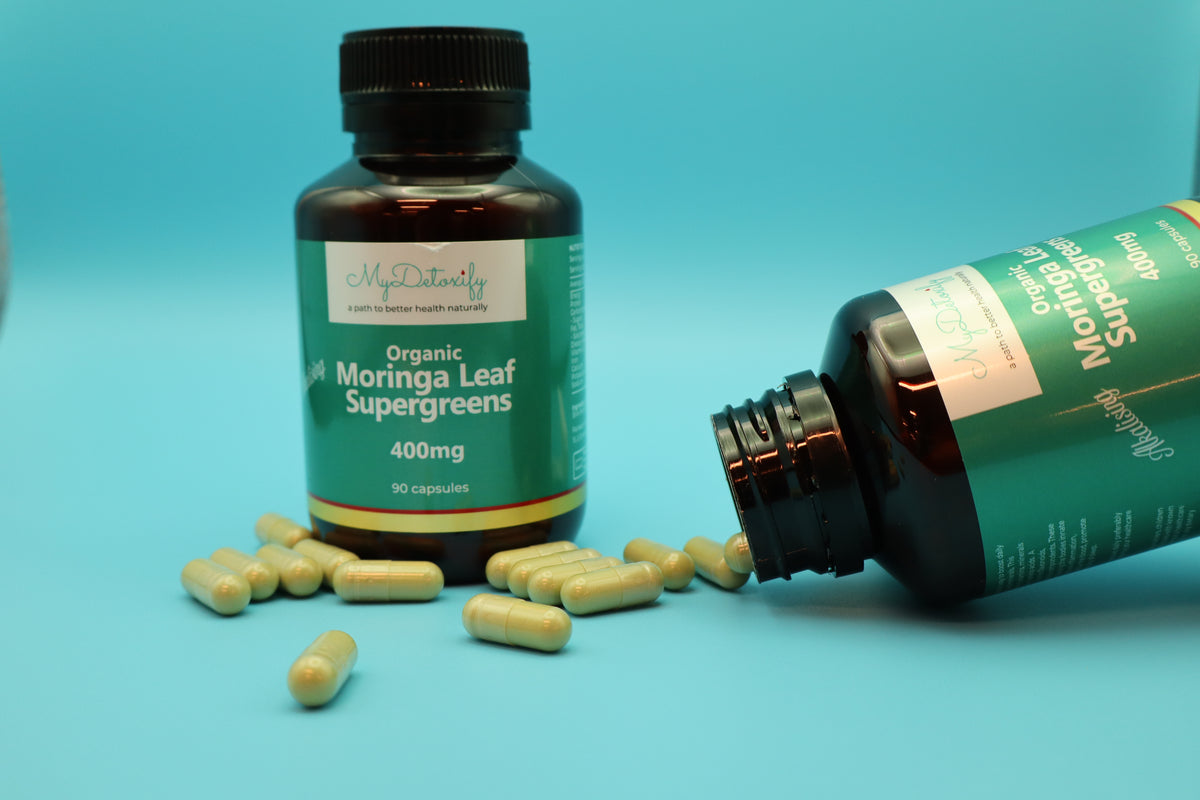
Organic Moringa Leaf Capsules
Naturally nourishing and beautifully simple, our Organic Moringa Leaf Capsules provide pure Moringa oleifera leaf in an easy-to-take capsule format.
Considered Nature's Multivitamin, Moringa has been valued for generations as a nutrient-dense green plant. Its leaves naturally contain a broad range of plant nutrients, including naturally occurring vitamins, minerals and phytonutrients.
Our organic Moringa leaf is carefully dried and powdered to preserve its natural nutritional profile, then encapsulated for convenient everyday use.
Why choose Organic Moringa Leaf?
- Made from organic Moringa oleifera leaf
- Naturally contains a variety of vitamins and minerals
- Plant-based source of naturally occurring nutrients
- Convenient capsule format
- No unnecessary fillers or artificial colours
- Suitable for everyday nutritional support
A simple way to add the natural goodness of Moringa leaf to your daily routine.
Ingredients: Organic Moringa oleifera leaf powder, vegetable capsuleIs Moringa Banned in Australia? What the 2025 FSANZ Decision Really Means
If you've recently searched for Moringa in Australia, you may have come across reports that it has been "banned". The situation is a little more complicated than that.
In November 2025, Food Standards Australia New Zealand (FSANZ) rejected an application seeking approval for Moringa oleifera leaf, immature green pods and seed oil to be used as foods or food ingredients in Australia and New Zealand.
As a result, these forms of Moringa are currently not permitted to be sold as ordinary foods or food ingredients under the Australian food regulatory framework.
However, this does not mean that FSANZ simply declared Moringa to be a dangerous plant, nor does it mean that every Moringa product is prohibited in Australia.
Why Did FSANZ Reject Moringa?
Moringa oleifera has a long history of traditional use in many parts of the world, particularly throughout India, Southeast Asia and Africa, where its leaves and pods have been consumed as part of the diet for generations.
When assessing the Australian application, however, FSANZ was required to consider Moringa under Australia's novel food requirements.
FSANZ concluded that the information available to it was not sufficient to establish the safety of Moringa leaf, immature pods and seed oil for use as foods.
The assessment identified areas requiring further evidence, including questions relating to reproductive effects, genotoxicity and the levels of certain naturally occurring plant compounds.
This distinction is important.
The decision was not simply a finding that normal consumption of Moringa had been proven harmful. Rather, FSANZ determined that the evidence submitted was not sufficient for the proposed food uses to meet Australia's regulatory requirements.
What About Moringa's Long History of Use?
Moringa is certainly not a newly invented ingredient.
Moringa oleifera, sometimes known as the drumstick tree, has been cultivated and consumed internationally for many years. Its leaves are commonly cooked as a green vegetable, its immature pods are eaten in traditional dishes, and dried leaf is used in a variety of preparations.
This history of use is one reason the Australian decision has generated significant discussion.
Traditional consumption, however, does not automatically satisfy Australia's requirements for a novel food. FSANZ assesses applications using its own regulatory and scientific criteria, including toxicological evidence and information relating to expected levels of consumption.
Does the FSANZ Decision Mean Moringa Has Been Proven Unsafe?
Not exactly.
FSANZ stated that it was unable to establish the safety of the Moringa products covered by the application based on the information available.
That is different from concluding that Moringa has been conclusively demonstrated to cause harm when consumed at ordinary dietary levels.
There remain scientific questions surrounding Moringa, particularly around dose, preparation, plant part and use during pregnancy.
This is why it is important not to reduce a complex regulatory decision to either "Moringa is perfectly safe" or "Moringa is dangerous". Neither statement accurately reflects the current Australian regulatory position.
Is All Moringa Illegal in Australia?
No.
The FSANZ decision relates to the supply of Moringa under Australia's food regulatory system.
Therapeutic goods are regulated separately by the Therapeutic Goods Administration (TGA).
Moringa oleifera is currently found in a number of therapeutic products included in the Australian Register of Therapeutic Goods (ARTG). Products supplied through this pathway must meet the applicable TGA requirements, including requirements relating to their ingredients, manufacture, labelling, indications and advertising.
This means the regulatory pathway under which a Moringa product is supplied is extremely important.
A Moringa product cannot simply be treated as an ordinary food because similar products have historically been available in Australia.
So, Is Moringa "Banned"?
The most accurate answer is:
Moringa oleifera leaf, immature green pods and seed oil are currently not permitted for retail sale as ordinary foods or food ingredients under the Australian food regulatory framework following FSANZ's rejection of Application A1294.
Moringa itself has not disappeared from Australia's regulatory system. Therapeutic products containing Moringa may still be supplied where they comply with TGA requirements and are appropriately included in the ARTG.
Why Is There Still Debate About Moringa?
Part of the debate centres around how evidence from laboratory and animal studies should be considered alongside traditional food use and human consumption.
Safety studies frequently use doses much higher than typical dietary exposure in order to identify possible hazards. These studies are valuable, but translating the results directly to ordinary human consumption can be complex.
At the same time, a long history of traditional use does not automatically answer every modern toxicological question.
The Australian regulator has therefore taken a precautionary position until sufficient evidence is available to satisfy the requirements for approval as a novel food.
What Happens Next?
The regulatory position could change in the future if additional scientific evidence is submitted and a new application is considered by FSANZ.
For now, businesses supplying Moringa in Australia need to carefully consider whether their product falls under the Food Standards Code or the therapeutic goods framework.
At My Detoxify, we will continue to follow developments surrounding Moringa and Australia's regulatory requirements and update our customers as further information becomes available. We are looking into a TGA listed product at the moment.
Important Information
This information is provided for general educational purposes and reflects the Australian regulatory position at the time of publication. Regulations can change. It is not intended as medical advice, and consumers should speak with an appropriately qualified healthcare practitioner regarding the suitability of individual products.
Take 2 Capsules daily preferably with food.